

Tree Troubles: How to Protect Your Trees From Damage
Topics Index
- What Tree Damage Looks Like in Virginia Landscapes
- Field Note: Chewing Damage
- Field Note: Sticky Leaves and Black Residue
- Field Note: Tree Worms and Webbing
- Field Note: Green Patches on Tree Bark
- Why Timing Matters
- Frequently Asked Questions
What Tree Damage Looks Like in Virginia Landscapes
Trees and shrubs can show pest problems in several ways. Some insects chew leaves. Others feed on sap, weaken branches, or leave behind sticky residue. Damage may start small, but it can spread quickly when heat, humidity, drought stress, or poor plant health are already stressing the landscape.
Tree pest control starts with correct identification. A brown leaf, thinning branch, or odd growth on bark does not always mean insects are the problem. Weather stress, disease, soil conditions, watering habits, and plant age can all create similar symptoms.
Field Note: Chewing Damage
What you may see:
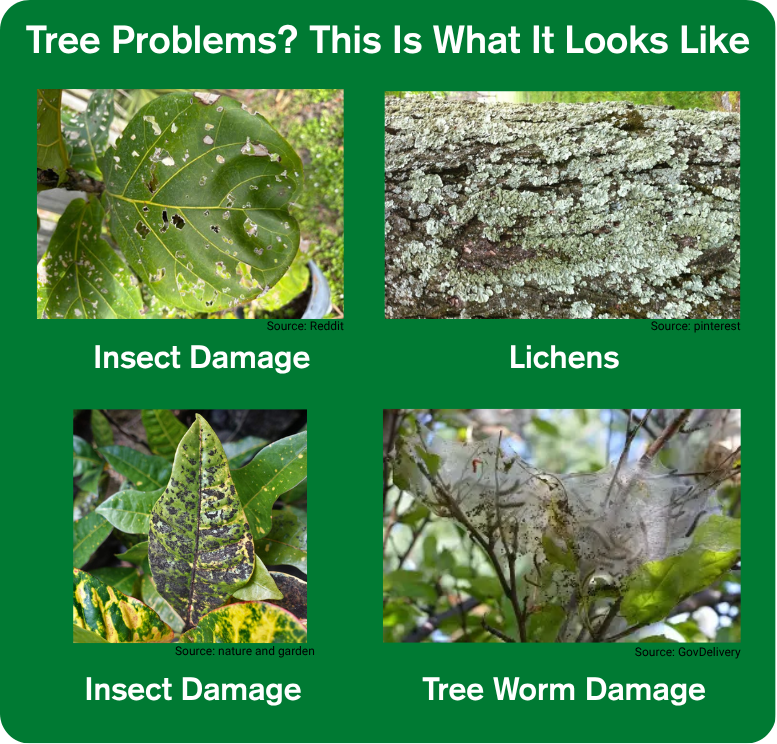
Holes in leaves, ragged leaf edges, missing needles, bare branch tips, or thinning foliage.
What it may mean:
Chewing insects may be feeding on the plant. Caterpillars, beetles, bagworms, and other pests can remove leaf tissue and weaken trees or shrubs, especially smaller or newly planted ornamentals.
What to do:
Look closely at the plant before treating. Check the undersides of leaves, branch tips, and interior growth. Some pests hide well, and others only feed during certain growth stages. Treating too late may not prevent much damage.
Field Note: Sticky Leaves and Black Residue
What you may see:
Sticky leaves, shiny surfaces under the tree, black coating on leaves, or ants moving along branches.
What it may mean:
Sap-feeding insects such as aphids, scale, or soft-bodied pests may be feeding on the plant. These pests can produce honeydew, which may lead to black sooty mold growth on leaves and nearby surfaces.
What to do:
Do not assume the black coating is the main problem. The pest feeding above it may be the real issue. Professional inspection can help determine whether the plant needs treatment, pruning guidance, or better overall plant care.
Field Note: Tree Worms and Webbing
What you may see:
Silken webs, moving caterpillars, hanging bags, leaf feeding, or clusters of larvae.
What it may mean:
Homeowners often call these pests tree worms, but many are actually caterpillars. Examples may include tent caterpillars, cankerworms, webworms, or bagworms. Some cause mostly cosmetic damage, while others can seriously stress trees and shrubs if populations are high.
Bagworms can be especially easy to miss because their bags blend in with the plant. They often look like small cones or bits of plant debris hanging from branches.
What to do:
Early detection matters. Smaller caterpillars are usually easier to manage than mature pests that have already caused heavy feeding damage. If you see repeated defoliation, webbing, or bag-like structures on evergreens or shrubs, schedule a professional inspection.
Field Note: Green Patches on Tree Bark
What you may see:
Gray, blue-green, or green patches on tree bark, branches, or older limbs.
What it may mean:
Green patches on tree bark are often lichens, not insects. Lichens are made from a fungus and an alga living together. They use the bark as a place to grow, but they do not take nutrients or water from the tree.
Lichens are usually not the reason a tree is declining. They may become more noticeable when a tree canopy thins and more sunlight reaches the bark.
What to do:
Do not scrape or spray the bark just because lichens are present. If the tree also has dead branches, thinning leaves, poor color, or branch dieback, the tree should be evaluated for the real cause of stress.
Why Timing Matters
Tree pest control works best when problems are found early. Waiting until a hedge is stripped, an ornamental tree is thinning, or branches are dying can make recovery harder.
Homeowners should check trees and shrubs during the growing season for:
- Ragged or chewed leaves
- Webbing or caterpillar activity
- Hanging bags on evergreens
- Sticky leaves or honeydew
- Black sooty residue
- Yellowing or thinning foliage
- Branch dieback
- Scale-like bumps on stems
- Repeated pest activity on the same plant
A quick visual check every week or two can help catch problems before they spread.
Complete The Look Of Your Lawn
-->
Frequently Asked Questions
What are common signs of tree pests?
Are tree worms harmful?
What are bagworms?
Are green patches on bark bad?
Should I treat every insect I see on a tree?